About Us

The Teenager's Book Club is a place to find a good book to read. You know how hard it is to find a good book. Well, all the books on the sight are books I've read and or reading. Some are good and others are not so good. My friends have also read most of the books. That's why I decided to start a book club. Because at my school we share books, well not literally share them,but one person will read a book and if it's good they will tell someone else to read it. That is basically the goal of this Book Club.

Monday, November 23, 2009

Along for the Ride


So, Along for the Ride was actually a good book, not on the same level as The Truth About Forever or Just Listen, but good none the less. It actually had a nice ending, which I don't say a lot, becuase it answered most of the questions posed throughout the story. The main characters were complex, but Auden seemed kind of uncaring until the end. There was a lot of personal development from all the characters, although they kind of all had the same problem. All in all it was a good read, and written in the typical Sara Dessen style.

Review/ Description
Studious good girl Auden, named for the poet, makes a snap decision to spend her summer before college at her father's beach house rather than with her mother, a professor whose bad habits include male grad students. Auden's parents divorced three years earlier, a split she's not yet over. Her remarried father has already produced another heir, a colicky baby named Thisbe (after a tragic figure from Shakespeare), with his young wife, Heidi, who owns a boutique. Feeling sympathy for stressed-out Heidi, Auden agrees to do the shop's bookkeeping, providing her with an instant social circle-the teenage clerks plus the boys from the neighboring bike rental, including hunky, wounded Eli. Both night owls, Auden and Eli bond when he coaxes her to experience childhood activities-bowling, food fights, learning to ride a bike-that her insufferable parents never bothered to provide.

Tuesday, November 10, 2009

Jane Eyre


Jane Eyre was a ver unusual sort of book, in my opinion. Not in the sense of its material being unusual just the characters. Really there were three stories going on throughout the book. The story of Jane's childhood, the story of Jane and Mr. Rochester, and the story of Jane's life after Mr. Rochester. In the end everything sort of works out, but a few characrers had some life changing events happen. I didn't agree with everything that happened, but I did like the book for the most part. It wasn't a Pride and Prejudice or anything, however it was worthy of being a classic.


Review/Description
Orphaned at an early age, Jane Eyre leads a lonely life until she finds work as a governess at Thornfield Hall, where she meets the mysterious Mr. Rochester and sees a ghostly woman who roams the halls by night. This is a story of passionate love, travail and final triumph. The relationship between the heroine and Mr. Rochester is only one episode, albeit the most important, in a detailed fictional autobiography in which the author transmuted her own experience into high art. In this work the plucky heroine is outwardly of plain appearance, but possesses an indomitable spirit, a sharp wit and great courage. She is forced to battle against the exigencies of a cruel guardian, a harsh employer and a rigid social order which circumscribes her life and position.

Sunday, September 13, 2009

Generation Dead


Basically teenagers across the country are dying, but they aren't staying dead. In the United States, zombies are walking around acting like the living, except a little slower. This was a rather weird book, in the zombie fact and that the main girl Phoebe likes a zombie. The ending really made me mad because Phoebe is such an idiot and doesn't realize Adam loves her until it's too late. Adam isn't a zombie by the way. There is a sequel I haven't decided to read it yet.


Review/Description
Phoebe Kendall is just your typical Goth girl with a crush. He's strong and silent.and dead. All over the country, a strange phenomenon is occurring. Some teenagers who die aren't staying dead. But when they come back to life, they are no longer the same. Feared and misunderstood, they are doing their best to blend into a society that doesn't want them. The administration at Oakvale High attempts to be more welcoming of the "differently biotic." But the students don't want to take classes or eat in the cafeteria next to someone who isn't breathing. And there are no laws that exist to protect the "living impaired" from the people who want them to disappear-for good. When Phoebe falls for Tommy Williams, the leader of the dead kids, no one can believe it; not her best friend, Margi, and especially not her neighbor, Adam, the star of the football team. Adam has feelings for Phoebe that run much deeper than just friendship; he would do anything for her. But what if protecting Tommy is the one thing that would make her happy?

Tuesday, September 1, 2009

The Princess and the Hound


He is a prince, heir to a kingdom threatened on all sides, possessor of the animal magic, which is forbidden by death in the land he'll rule.
She is a princess from a rival kingdom, the daughter her father never wanted, isolated from true human friendship but inseparable from her hound.
Though they think they have little in common, each possesses a secret that must be hidden at all costs. Proud, stubborn, bound to marry for the good of their kingdoms, this prince and princess will steal your heart, but will they fall in love?


A classic love story that isn't really sappy. The prince, which can understand and talk to animals even though animal magic is considered evil, is going to marry Princess Beatrice who loves her hound more than anything. In a lot of eventful situations the true nature of everyone and everything comes into play, and people aren't really who you think they are or what you think they are for that matter. A really good storyline and ending. Both prince and princess realize their true potential and their love for each other at the same time.


Review/Description
Prince George must keep his ability to talk to animals a secret. In Kendel, animal magic is punishable by death, and the fear and loathing toward practitioners is reminiscent of the witch hunts of medieval Europe. Even as royalty, George cannot reveal his secret. Lonely and isolated, George accepts his betrothal to Princess Beatrice as a political alliance, expecting never to trust enough to find love. But when George and Beatrice meet, George is drawn to Beatrice and the beautiful hound, Marit, who is her constant companion. In the pair, George finds not only trust but also others whose lives have been touched by animal magic. George is not a typical Prince Charming, but Beatrice has the feel of a damsel in distress. Both need rescuing in their own ways, and Harrison sets up a story that draws readers into their growing relationship. George, the infatuated prince, is an atypical fairy-tale narrator. His perspective adds depth and insight to his character, but Beatrice's chilly personality is less developed. Her isolation is just as apparent as George's, and he is drawn to her through their shared loneliness. George's growth from prince to king is admirable, especially as he learns to accept his shortcomings and his secret abilities and forgive himself his past mistakes.

Friday, July 31, 2009

Bride Most Begrudging


This book really surprised me. I don't generally like books set back in the 1800s, but it was funny and had sarcasm in it. It was written really well and the story was really interesting too. I loved the ending, it was a true romance book and had a fairly happy ending. The main character, Constance, was hilariously difficult to deal with. Drew was a good man and was able to put up with her most of the time. I would absolutely reccomend this book.


Review/Description

Any ship arriving from England means good news for Virginia colony farmers. The "tobacco brides" would be on board--eligible women seeking a better life in America, bartered for with barrels of tobacco from the fields.
Drew O’Connor isn’t stirred by news of a ship full of brides. Still broken-hearted from the loss of his beloved, he only wants a maid to tend his house and care for his young sister.
What he ends up with is a wife--a feisty redhead who claims she is Lady Constance Morrow, daughter of an Earl, brought to America against her will. And she want to go straight back to England as soon as she possibly can. She hasn’t the foggiest notion how to cook, she dares to argue with her poor husband, and spends more time working on mathematical equations than housework. What kind of a wife is that? Drew's Christian forbearance is in for some testing.
Headstrong and intelligent, deeply moral but incredibly enticing, Constance turns what was supposed to be a marriage of convenience into something most inconvenient, indeed.

Tuesday, May 12, 2009

Salem Falls


So I haven't really been in a readin mood lately. it took me almost a month to read Salem Falls because I got into it,but I couldn't really stay into it that long. In the beginning it starts out a little confusing; all the characters are introduced separately and it tells a bit about their pasts. Eventually they all tie together. Jack has just gotten out of jail for sexual assualt, Addie runs the Do-or-Diner like her life depends upon it since her daughter died, and everyone just falls into their story. By accident and on purpose. it seems like everything in the world is against Jack, just an ordinary guy who raped one of his students; or so everyone believes. But in Jodi Picoult's world nothing is as it seems until the very end, when you begin to find out what really happened.


Review/Description


Jack St. Bride comes to Salem Falls, after his release from prison. The former teacher and soccer coach wants to start a new life following a wrongful conviction for statutory rape. Unfortunately, Salem Falls turns out to be the wrong place to do it. He has no trouble landing a job at the local diner and winning the trust of the diner's eccentric owner, Addie, but the rest of the town is suspicious. Things get dangerous when manipulative 17-year-old Gillian Duncan, whose father owns half the town, gets interested in Jack and tries to seduce him with Wiccan love spells. Then Gillian is assaulted in the woods, and Jack is accused of the crime. As the courtroom battle unfolds, many secrets are revealed, and Picoult's characters are forced to confront the difference between who people are and who they say they are. The difference is considerable: despite the townspeople's aura of virtue, by the end of the book we're hard pressed to find any women who have never been raped or threatened, or any men who are really innocent of violence.

Monday, March 9, 2009

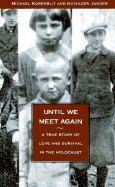
Until We Meet Again


A True Story of Love and Survival in the Holocaust


This was a really good nonfiction book. It reads just like a novel. Most holocaust stories are really depressing, but this one even though it has some really sad parts and the characters have to go through so many struggles, their love for each other lightens up the story a little. it shows how even though you may be all alone memories can keep you going. it even has a happy ending. If you have to read a nonfiction book for school I definitely recommend this book. What happened to the Jewish people was horrible, and i had never really read anything that detailed what they went through like this book.


Review/Description

In 1942, Korenblit's parents, Manya and Meyer, were teenagers in love in Hrubieszow, Poland. But they were also Jewish and soon found themselves torn from their families and each other as they were shifted from camp to camp. Before they were separated, though, the two promised to meet in their hometown at the end of the war, which they did--two of the fewer than 200 surviving members of the 8000-strong Jewish community that had lived in Hrubieszow before the war. The writing here just is not as powerful as the facts, however. One strategic choice depletes much of the suspense: Korenblit reveals in an introduction that while researching the book, he discovered one of his mother's brothers living in England. It's a fantastic detail, initially well told, but by the end, when it is repeated, it sounds pedestrian. Other techniques lessen dramatic effect. For example: while in the camps, Manya kept an ersatz diary, jotting down daily events in terse lists such as ``Cyvia, joy, horrible condition, no hair, Cyvia better, new friend, replaced shoe, washed dress, farmwork'' which she rolled into tight cylinders and concealed in her hair. Rather than relying on the lucidity of those original notes, Korenblit and Janger imagine what Manya would have written had she had the paper and the time.